Showing posts with label dog. Show all posts

Tuesday, November 13, 2007

Road Trip With Rover

Is a trip to the vet your dog’s idea of a car ride? Broaden your friend's horizons, and lessen his neurosis, with mini-road trips.

If your dog only travels in the car to go to the vet or other angst ridden locations, start slowly, beginning with short trips to the dog park or to a friend’s house. Once your dog begins to associate the car with pleasant outings, increase the length of the ride.

Try not to feed your dog a few hours before you travel. A full stomach may intensify upset if your pet is prone to motion sickness. If your dog does exhibit signs of motion sickness, such as excessive drooling, park the car and go for a brief stroll.

Never leave your dog in your car unattended. This is especially true during the hot months when temperatures rise rapidly in a closed car. Even opening the window slightly does not allow sufficient air to circulate. Dogs left in hot cars can suffer heat stroke or even death.

Keep a few treats with you for the ride and give your pet a reward. Stopping for lunch at the drive through? Enjoy your meal while your pet enjoys her treat.

For warm days and longer trips, take along water for your dog to drink and a spray bottle filled with water for a quick pooch pick-me-up. Remember to pull over every few hours for a bathroom break and leg stretch.

If your dog insists on sticking his head out the window for the aux natural feel, make certain he is wearing goggles or secure eye protection.

Put your dog on his leash before exiting the car to help avoid quick uncontrolled escapes.

Buckle up. Invest in a dog harness, seat belt restraint, car seat or crate for your dog.

The doggie car booster seat from www.dogclothes-apparel.com is the perfect solution to safely satisfy your pet's natural urge to look out the window. The seat easily attaches to your car's passenger seat and includes an adjustable safety harness for for added protection.

Monday, November 05, 2007

Making Arrangements For Your Dog After You're Gone

No one likes to ponder their own demise, but making arrangements for your dog's care if you are no longer present is a point all dog parents should consider.

The Internet is a great source of information regarding providing for your dog and/or forming a pet trust. The ASPCA (http://www.aspca.org/ ) has a thorough and concise section specifically related to the legal aspects of your dog’s care as does the Humane Society of the United States (http://www.hsus.org/). Enter pet trust in the search box to locate the information.

Other sources include consulting with a pet trust attorney regarding a pet trust for your dog or consulting your state or local Bar Association's web site for information regarding your particular state. Some sites also provide sample wills and documents which may be used as templates for your specific needs. Pet trusts are currently permitted under law in 28 states.

When planning, consider the following points:

Who Will Care for Your Pet
Designating Funds for the Care and Feeding of Your Dog
Establish a Pet Trust
Emergency Instructions
Designating Short Term Care For Your Dog if You are Ill
How Unused Trust Monies be Used

By establishing a Pet Trust, you designate someone (both primary and secondary) to care for your dog and note how the finances will be handled to provide for his or her life-long care. Monies can be given in a lump sum, apportioned monthly, annually or left to the discretion of the executor. You will also need to provide funds to administer the trust.

Make certain care instructions are clearly designated and make note of any health issues or special circumstances which should be taken into consideration.

Another site worth consulting is the Doris Day Animal League (http://www.ddal.org/). Their resource page provides a list of additional resources for further information (www.ddal.org/pettrust/resources/).

If you prefer, you may also contact these organizations in writing or by telephone.

Doris Day Animal League or the Humane Society of the United States
2100 L Street NW
Washington, DC 20037
202.452.1100

American Society for the Prevention of Cruelty to Animals (also the ASPCA contact info.)
424 E. 92nd St
New York, NY 10128-6804
212.876.7700

Tuesday, September 25, 2007

Playing With Your Dog

We all need time to play and your pet is no exception. Your dog will sleep better and experience fewer behavioral problems with frequent exercise. Here are a few tips to help you and your dog on your way to better health.

If exercise is new to your dog or if you are exposing him to a new sport, begin slowly and gradually increase the duration and level of activity.

Make certain to keep your dog hydrated. Take along a supply of water and give some to your dog during rest periods. Always be aware of the temperature and the climate so your pet does not suffer from heat exhaustion.

Pay attention to signs of fatigue. If your dog sits down while you are playing she may be fatigued and need a break.

Walking and running with your dog are always good forms of exercise. The intensity level can be increases for dogs in good health or lessened for older, sickly or physically impaired pets. Try to keep walks between 20 to 40 minutes; enough time for your pet to derive the benefit of the exercise, but not too much to create fatigue.

Vary the games you play with your dog such as fetch, ball retrieval, Frisbee, agility training exercises and flyball.

When training your dog to play Frisbee, begin with a small fabric covered disk. If your dog takes to the sport and shows an aptitude, switch to a regular Frisbee for your play time.

Some dogs love agility training and even progress to competitions. Agility training exercises include jumping through tires, climbing steep inclines, running through dog tunnels, walking beams, and weaving through poles. The rapid pace of these events make dogs think and use their skills to navigate the course successfully. For more information on agility exercises and competitions contact the United State Dog Agility Association at http://www.usdaa.com/ or call them at 972.487.2200.

Before you take your dog for a jog, check with your vet to make certain your pet is in good health and capable of such strenuous activity. Avoid running during midday when the temperature is hottest. Running on grass, sand or softer surfaces help protect your dog’s pads and provide some cushion. If you run in the evening or at night, make certain you and your dog wear garments with reflective tape to make you more visible.

On inclement days, it is still important for your dog to get exercise. A good game of hide and seek may do the trick.

Zack and Zoey High Top 100% Neoprene Dog Boots from http://www.dogclothes-apparel.com/ provide extra protection from all types of bad weather and difficult terrain. Wear-resistant Neprone provides excellent insulation and high uppers give added protection to dog’s legs. The Velcro closure ensures a snug fit on the ankle while the front zipper allows for easy on and off. The boot’s rubber soles leave a whimsical “paw” print on snowy or muddy surfaces. Spot-clean when needed with soap and a damp cloth and air dry. Available in Green, Red and Blue / all sizes.

Tuesday, September 11, 2007

Your Dog’s House

Whether indoors or out, your dog will enjoy having his own space. Here are points to consider as you go in search of a dog house.

Make certain the doghouse has nontoxic paint, especially if your dog likes to chew.

If the dog house is located outdoors, consider purchasing a house with a hinged roof or side to allow for easy access and cleaning. For indoor houses, a removable, washable floor pad .

If you choose to line the floor, avoid products which may become moldy or items such as newsprint which can run, discolor your pet’s fur, or cause an allergic reaction. Remember to clean the dog house regularly.

Consider ventilation. Look for windows and doors which allow good air flow.

Measure the dog house to make certain it is large enough for you pet to fit comfortably. Dogs depend on their body heat to warm confined spaces. If the house is too large, your dog will be unable to heat the space and may become cold. For a proper fit, your dog should be able to stand and turn around without touching the sides.

Point the front opening away from oncoming winds. For additional protection, attach strips of overlapping plastic over the front door to keep out the elements and unwanted insects.

Purchase a dog house with a slanted or pitched roof so rain and snow slide off.

During flea and tick season, lightly spray the inside of the house with weekly with repellant. Make certain to let fumes clear before your dog enters.

Perfect for the indoor small dog, the Paw Prints Collapsible Dog House from www.dogclothes-apparel.com provides a stylish and comfortable place for your loved one. Fully cushioned on all sides for firm support. Strong when assembled, heavy duty Velcro fasteners allow it to disassemble in seconds for easy mobility. This little house is great for protecting your pet from drafts and giving them the security they love.

Thursday, September 06, 2007

Taking Your Pet to the Dog Park

As the number of dog parks increase, it is important for your pet to put his best paw forward when out romping.

Before going to the dog park make certain your dog’s vaccinations are current and your pet is familiar with commands such as sit, stay and come. Even when he is off the leash, make certain you have control over your pet to keep her out of harms way.

Make certain your pet is wearing an ID tag and that the information is current.

Leave little pups at home until their immune systems have developed fully and they are able to listen to and heed your commands fully.

Know your dog’s temperament. Some aggressive dogs will not do well at a dog park or more timid dogs may be overwhelmed by the number of dogs and general chaos. Plan ahead and have an exit trategy should events go awry. For his safety, watch your dog at all times.

Bring water in case your dog gets thirsty.

For a listing of dog parks in the United States and Canada go to http://www.dogpark.com/

A perfect complement for the Puppia Spring carrier or lovely by itself, the Spring Harness and Lead from http://www.dogclothes-apparel.com/ will brighten any day. Bold Pink or Sky Blue plaid is edged in matching solid color trim. Inner filter and adjustable waistband make the harness a comfort to wear. Available in Pink and Sky Blue.

Tuesday, July 24, 2007

Moving With Your Dog

Dogs are sensitive to our emotions, so when the time comes to move, it can be a hardship on both you and your pet. Here are a few ways to help your pet feel more comfortable and secure.

When looking for a new home, try contacting the local humane society in the new area for a list of dog friendly landlords.

Write a resume for your dog. Landlords may be wary about accepting a new tenant with a pet. To help put minds at ease, write a curriculum vita accentuating all of your dog’s wonderful qualities to present to potential landlords. Include letters of recommendation from your vet or current landlord as well as sitters or groomers. If your dog has attended obedience class add that too. Also include current health records and inoculations.

When the movers come, place your dog in a room away from the commotion until the movers are finished. Put a few of his favorite toys in the room with him and make occasional visits to the room to help your dog feel more secure.

Once you move, recreate a special place for your pet similar to the one he had at your old home. It gives your dog a new safe place and makes him feel like part of the family.

Perfect for the small dog, the Pretty Paws collapsible dog house provides a stylish and comfortable place for your loved one. Fully cushioned on all sides for firm support. Strong when assembled, heavy duty Velcro fasteners allow it to disassemble in seconds for easy mobility. This little house is great for protecting your pet from drafts and giving them the security they love. Measures 25" L x 20" W x 25" H

Tuesday, May 15, 2007

Massaging Your Dog

Dogs and cats know how to stretch and do so frequently throughout the day. To really pamper your pet, give him a doggy massage. Not only does it make him feel good, it also provides a good bonding moment for you and your dog.

To properly massage your dog:

Let your dog tell you when she is ready for a massage. Forcing your pet to have a massage may cause more stress than calm. If your dog seems agitated or disinterested, wait for another time when she is more open to some quiet time. The same goes for you.

Use your hands for massage not your feet or elbows. Your hands are more sensitive to your pet’s body and will be able to adapt better to your dog’s needs. Remember not to press too deeply.

If your dog has been injured (i.e. a cut) or has recently had surgery, avoid massaging the injured area directly. Instead, gently massage the periphery a few inches around the injury. This helps promote blood flow to the area which is healing.

Use long smooth strokes when massaging and stroke the muscles toward the heart to promote good blood flow.

Look for abnormalities on your pet such as fleas, lumps, cuts, scabs, or ticks. Consult your vet if you have any questions or concerns.

For older dogs, stretching the legs gently will give pleasant relief to the joints. While your dog lies on his side, gently hold his front or back leg above and below the joint. Stretch the leg slowly toward the head and hold this position for 3 to 5 seconds. Then slowly stretch the leg toward the tail until you feel slight resistance. Again, hold in this position for 3 to 5 seconds. The hold time can be increased as your dog adjusts to the stretching and becomes more comfortable.

The www.dogclothes-apparel.com Sweet Dreams Dog Pajamas are perfect for every pampered pooch. Four-legged construction keeps your dog warm and snuggly. Full body PJ has finished arm and leg holes and is decorated with festive prints. Available in Blue, Lilac, Yellow and Red.

Wednesday, May 02, 2007

Safe Toys For Your Dog

When purchasing toys for your dog, don’t forget to exercise precaution.

Avoid potential choking hazards such as toys with breakable doors, glued-on or removable parts.

Make certain the noise box in squeaky toys cannot come out during rough play.

Choose toys which are made from durable and wear resistant materials such as vinyl, nylon, and latex. Toys made from hard rubber are better than softer materials which may shred or tear.

Avoid playing with old shoes, socks or any other item which may be off limits under different circumstances. Using these items as toys makes your dog think it’s OK to play with them even if they aren’t his toys.

Look for brightly colored toys which will keep your dog entertained. Food dispensing and chase toys are two great time occupiers.

Avoid tug of war games which support aggression tendencies. Tugging on a toy may be acceptable. Tugging on your clothes is not. Tug of war games with your puppy may also damage the alignment of your dog’s teeth.

Vary your dog’s toys as she gets older. What might keep a puppy entertained for hours may not hold the same allure for an older dog.

Let the festivities begin with the Dolly Dog Carrier from www.dogclothes-apparel.com. Bright white dots adorn these vibrant sky blue, pink and green PVC carriers. Mini bag and collar and lead set included. Available in Pink, Sky Blue & Green. For pets up to 11 pounds.

Friday, April 20, 2007

Home Sweet Crate – Crating Your Dog

If you chose to crate your pet, here are a few suggestions to make your dog’s crate home sweet home.

Avoid using your dog’s crate as a punishment area. Your dog associates his crate with privacy and security – a second home. When the crate is used as a punishment area, your dog will think of the crate as a prison and not a safe place to sleep and spend time.

Purchase a crate roughly one and a half times the size of your dog - just large enough to permit your dog to stand up, turn around and lie down. Make certain the crate is well-built and strong enough to support your pet's weight.

Make your dog feel comfortable by adding a few of her favorite toys. For younger dogs that are not completely trained, add clean newspapers for the bottom of the crate and clean them regularly. For older dogs, a 3” washable cushion or bed pad will help sooth aching joints.

Locate the crate in an area with good air circulations. Leave the door open when you are home so your pet can enter and exit the crate as he pleases.

When you and your dog are out and about, keep your pet close with this comfortable and convenient Outward Hound Sling-Go Small Dog Carrier from www.dogclothes-apparel.com . The sling bag is durably constructed and offers hands free mobility. The broad strap helps keep your pet secure while distributing weight evenly across your shoulder. Available in Black, Blue, Red and Green. Accommodates dogs up to 20 pounds.

Monday, April 09, 2007

Taking A Vacation With Your Dog

Traveling with your dog is becoming more and more popular, but remember to do your homework before you go. Here are a few helpful hints to make your travels easier.

The Internet can be one of your best sources of information. Pet Friendly Hotels (http://www.pets-allowed-hotels.com ) and Take Your Pet.com (http://www.takeyourpet.com ) are two good sites for pet friendly lodging, travel tips, bulletin boards and other travel resources.

Consider what activities both you and your dog will enjoy. Locations such as state and national parks are perfect for walking, hiking and exploring. For a complete list of dog friendly parks, visit the National Park Service’s web site at http://www.nps.gov

Not certain where to go? Contact the Chamber of Commerce in a city of interest or the Department of Tourism in the state you may want to visit. Travel agents may also be helpful in finding pet friendly places.

If you are flying with your pet, remember to call the airline early and notify them you will be traveling with a dog. Make certain your dog carrier will meet airline requirement. Many airlines will provide carriers for a cost.

Cool and comfortable, the www.dogclothes-apparel.com Minx Dog Top is perfectly detailed. The colorful mesh fabric is accented with floral pattern trim and button detail. For the perfect combination, finish the outfit with a matching Minx Skirt made from flexible cotton with an adjustable waist band. Top available in Pink, Sky Blue, Green and Camo. Skirt available in Pink, Sky Blue, Violet/Green, and Camo.

Monday, April 02, 2007

Puppy Etiquette

Yes, puppies are cute, cuddly and adorable, but they also need a bit of guidance when it comes to manners. When your puppy is little, preferably between the ages of 5 and 14 weeks, begin to build his confidence and instill trust in his family by introducing him new experiences .

Acclimate your puppy to his new home. Noises such as the vacuum, dishwasher and dryer may initially startle him, but with your supervision, guidance and support he will begin to take his new surroundings in stride.

Socialize your dog by introducing him to new people and other animals. The more positive experiences he has as a pup, the better adapted he will be as he grows.

Investigate puppy etiquette and training school.

Teach your dog trust. Don’t hit your puppy. Instead, give commands in a strong, decisive tone. Hitting your dog at an early age can instill fear of hands and a fear of you and his surroundings.

To avoid separation anxiety, keep good-byes to a minimum. Before leaving home, give your dog a toy to keep him occupied and leave the house without saying a word. When you come home, keep your arrival low key. The more accustomed your dog becomes to your departure and return, the more comfortable and independent he will become.

The Pink Satin Dog Bathrobe from www.dogclothes-apparel.com is perfect for the dog that has everything. Elegant and luxurious, this super-soft satin bathrobe comes in bright pink with faux fur collar and cuffs. Available in sizes: X-Small, Small, Medium, Large and X-Large

Tuesday, March 20, 2007

Dining with Your Dog

If meal time is your dog’s favorite time of day, here are a few tips to make dining even more enjoyable.

If your dog has mastered begging as an art form, try diverting her attention by going for a walk or playing a game.

After each meal, throw out any remaining food and wash your dog’s bowls. Dirty dishes provide a breeding ground for bacteria.

If your dog eats when you do, feed her in a room away from the dinning room to curb begging.

In warm weather, add a few ice cubes and keep a fresh supply of water available to help your dog stay cool.

If your dog enjoys snacking, consider purchasing an automatic dry food dispenser, but don't forget to check and make certain your dog is not overeating or experiencing weight gain when self-feeding.

Dogs love cheese, but too much can cause diarrhea.

Use stainless steel dishes for food and water bowels. Dogs who are chewers or like to gnaw can puncture plastic or chip porcelain bowls inviting bacteria or creating dangerous porcelain chips.

Low fat foods might be a plus for people, but dogs need fat to maintain healthy skin and coats. Age and size determine how many calories you dog needs. Smaller dogs burn more calories where as older dogs need fewer calories. When planning your dog’s diet consider his age, weight, health and amount of activity for an overall healthy diet.

Show off your dog's sparking personality in the Lumino-Metallica Dog Hoodie from www.dogclothes-apparel.com. Made of 100% cotton, this sleeveless hoodie is decorated on the back with a luminous print. Perfect for a night out on the town or just showing off.

Tuesday, March 13, 2007

Home Sweet Home For You and Your Dog

We all like to have a home sweet home, even your dog. With that in mind, here are a few ideas to make you and your dog's time at home even more enjoyable.

Situate your dog’s bed in a well traveled area of the house. Dogs are social animals and like to be close to the family even when resting.

Cover your sofa with a blanket or towel to give your dog a soft place to lay. It also saves time cleaning fur off the furniture.

Keep garbage in a covered trash can or cabinet to help curb your pet’s trash attraction.

Keep small objects, such as jewelry and spare change in a safe place, e.g. a drawer or jewelry box, to prevent accidental swallowing or choking.

Place snuggly rugs on hardwood or tile floors where your dog sleeps. Not only will your dog enjoy the comfort, the rug will also protect his joints from cold floors and cold air which sinks to the ground. As an added bonus, place the rug in a sunny spot.

Purchase a vacuum with beater bars to beat out fur and dander from your carpet. A vacuum with HEPA filter will also help trap irritants which can cause allergies.

Our distinguished young Miss is wearing the Puppia Olive Dog Jumper from www.dogclothes-apparel.com. The hooded shirt and corduroy jumper combination are unique and stylish with just the right sporty edge. A delicate matching belt and top buttons compliment the two tone outfit. This adorable combo will turn heads and make your pup feel great.

Monday, March 05, 2007

Finding A Vet For Your Dog

Having a knowledgeable and compassionate veterinarian you trust is one of the most important aspects of being a pet parent. But how to find a good one?

One of the best ways to find a new vet is to speak with other pet owners. Chat with dog parents in the park or when you go for a walk. Often, people will be able to guide you to doctors with a good reputation and away from those you may not want to see. Or contact a dog club near your home.

Visit the American Animal Hospital Association web site (http://www.healthypet.com) for useful information regarding pet care. It is also the only association which accredits animal hospitals throughout the United States and Canada. Take the Healthypet hospital tour or click on their accreditation site (http://www.healthypet.com/hospital_search.aspx) to locate an accredited vet or hospital near you.

Before scheduling your first appointment, visit the veterinary facility without your pet. Ask questions and note your first impressions. Is the office clean? Is the staff helpful and friendly? Do they have night and weekend hours? Emergency services? If you feel comfortable with the surroundings, you will convey that feeling to your dog.

Drop by the office with your pet. Before going for your appointment, consider taking your dog to the vet for a trial run. Let him see the surroundings and meet the staff to develop good associations with the office.

On your first appointment, take along a few treats to help put your dog at ease in his new surroundings.

Show your love with the www.dogclothes-apparel.com Agape Dog Sweater. This cute sleeveless sweater has a finished rounded neck and solid color bodice with Jacquard heart pattern and boa corsage pin.

Monday, February 26, 2007

Leaving Your Dog Home Alone

Does your dog become overly anxious when you leave the house or upon your return? Could be he is suffering from separation anxiety - a severe fear and dislike of isolation. Dogs who have experienced traumatic events such as a sudden change in environment, loss or addition of a family member, or lack of attention and mistreatment early in life may be more prone to excessive dependence and separation anxiety.

Indications of separation anxiety will generally begin approximately thirty minutes before you leave. Signs include destructive behavior or scratching at the door shortly after you leave, constant or excessive barking, whining or whimpering, hyperactivity, increased aggression, depression, or urination/defecation in inappropriate areas. If these behaviors exhibit themselves consistently when you are leaving or while you are gone, here are a few ways to help your pet feel more secure.

Plan scheduled departures. This technique helps your dog adjust by exposing her to repeated short periods of isolation. Spend 5 minutes with your dog to put her in a calm state. During this time, do not touch or talk to her. Then gather your keys and leave your home for a few seconds to a minute, making certain to return before your dog becomes anxious. When you reenter the house, do not talk or touch her. Wait a few minutes before greeting your dog or causally calling her by name. Repeat this procedure until your dog shows no sign of distress. Before increasing the separation time, make certain your dog is calm and does not engage in an extended greeting when you reenter. Continue this process, gradually increasing the length of separation time. After the short departures have reached 30 minutes, increase the alone time in larger increments. Once your pet can be left alone for an hour and a half without anxiety, she can generally be left all day. Remember to consult your vet or an animal behaviourist to design a treatment program for your dog.

Give your dog more exercise, both mental and physical. Take your dog to the park for an extended run, explore new places, go for a play date with other dog buddies or teach him a new training exercise.

Make your departure and return as uneventful as possible to avoid over stimulation.

Leave a recently worn article of clothing where your dog sleeps. Your scent will help ease his anxiety.

Watch the signs. Look for the earliest action in your predeparture sequence which makes your dog anxious, such as putting on your shoes or picking up keys? When you are home, repeat these triggers in a normal fashion until your dog becomes comfortable with them, then move on to the next step in your departure sequence. If your dog's anxiety does not decrease after a number of repetitions, you may need to reassess what the first trigger is and try again.

Leave the TV or radio on for your dog to hear while you are away, providing the dog does not associate these items with a stressful situation.

Leave a hard rubber toy for your dog filled with her favorite treat (peanut butter, cheese, kibble, etc.) . This provides a distraction and keeps her occupied while you are away. It will also focus her attention on the toy and not on the destruction of your furniture.

When your pup is young, consider crate-training to establish independence and safe alone time.

Have patience.

Perfect for those special occassions, our little girl is wearing the all cotton Puppia dress with pink top, white sailor collar and matching plaid skirt. Available at: www.dogclothes-apparel.com

Monday, February 19, 2007

Poisonous Substances and Your Dog

No matter how smart your dog, as pet parents, we need to help our friends stay as safe and healthy as possible. Below are a few simple tips to keep your dog in tip top shape.
Dogs may eat grass to help with indigestion, but certain plants can be toxic if ingested. Caladium, Castor bean, Day Lily, Dumbcane, English Ivy, European Bittersweet, Lantana, Mistletoe, Oleander, Philodendrons, Poinsettia, and Rhubarb are just a few which can cause your dog serious harm. For a complete list, go to the Humane Society web site http://www.hsus.org/ and enter poisonous plants in the search box.

Place cleaning products as well as shampoo, soap, and hair products out of reach.

Clean automotive spills or leaks promptly and avoid using antifreeze containing ethylene glycol. The sweet taste can be attractive to your pet, but just 2 ounces of an ethylene glycol antifreeze can be fatal.

Although a treat for our palette, chocolate contains the stimulant theobromide which poses serious health risks for dogs.

Sign up for a dog first aid class. Contact your vet, the Humane Society (http://www.hsus.org/) or the ASPCA (http://www.aspca.org/) for classes in your area.

Keep a list of poison control numbers handy. In the event of a poisoning emergency, call your vet immediately or the ASPCA's Animal Poison Control Center (888-426-4435) which is open 24 hours a day, 365 days a year. A $55 fee may be applied to your credit card for calls to the APCC (http://www.aspca.org/site/PageServer?pagename=pro_apcc).

Know the signs. Dogs who have ingested poison generally display some of the following symptoms: fever, diarrhea, stomach pain, listlessness, lack of coordination, vomiting and tremors. If your pet has ingested something poisons, contact your vet immediately.

Our little friends are wearing the Puppia Knight Hoodie from http://www.dogclothes-apparel.com/. This sleeveless polar fleece dog hoodie is adorned with a gold Puppia "P" on the front and a noble crest appliqué embroidered on the back. The checked bodice is finished in matching color trim. Available in Pink, Red and Navy.

Tuesday, February 13, 2007

Bathing Your Dog

We may enjoy a long soak in the tub or a hot shower after a grueling day, but often our furry friends don't share our bathing enthusiasm. Here are a few helpful hints to make cleanliness a less life altering experience.

Bath time can be a stressful time for some dogs. Speak to your pet in a friendly, comforting tone. Just hearing your voice will reassure your dog all is well.

If the outdoor temperature is below 65 degrees (19 C) bathe your dog indoors. In addition, most outdoor faucets only pump cold water.

Both pet and baby shampoos work well when bathing your pet. Rinse your dog with warm water before applying shampoo or put a few drops of shampoo in a large container of warm water. Pour over your dog before you wet her to help remove stubborn oils and dirt which have accumulated in the fur. Begin shampooing at the head working your way to the tail. Rinse twice using the same head to tail movement. Use the second rinsing to make certain all the shampoo has been removed from the skin.

Where you bathe your dog makes a difference too. For large dogs try the shower. Medium dogs can be washed well in either a deep sink or the bathtub. For small dogs, try the kitchen sink. Place a towel in the sink or a nonslip mat in the shower for added traction. If possible use a hand held shower attachment to make your life easier.

And don't forget, bring your sense of humor.

Our furry friend is wearing his after bath best.. the http://www.dogclothes-apparel.com white Terry Cloth Dog Bathrobe with applique rubber duckie. For the finishing touch, add a set of Sleepytime Dog PJ's or Yellow Duckie or Pink Bunny Dog Slippers. Available in all sizes.

Wednesday, February 01, 2006

Fitness with Your Furry Friend

Don't feel like exercising? Use your dog as an excuse. Romping with your dog is a great way for you both to keep fit and have fun in the process. Hiking, walking, biking, swimming, or running are all activities your dog will enjoy.
If you and your dog have don't exercise much, begin slowly. Starting your work out too vigorously too soon can cause more harm than good.

For older dogs, swimming is a great way to stay fit. Water's buoyancy relieves stress on older joints, while swimming exercises the muscles. For pool play, add a floating dog toy for your dog to enjoy. Remember to allow you dog to go at his or her own pace.

After swimming, dry your dog's ears to help prevent ear infections.

When hiking, plan rest periods every 20 to 30 minutes. Take water for your dog to drink and make certain your pet is properly hydrated before you leave home.

When biking with you dog, make certain you take the necessary precautions first. Only take your dog along if you are a good cyclist and if he likes to go. Train your dog to run beside you - not in front, keeping pace with your speed. If your dog is harnessed to your bike, make certain the attachment has a quick release.

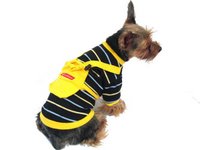
Max is wearing the http://www.dogclothes-apparel.com/ Backpack Shirt. Backpack and shirt in one. Made of stretch cotton with light blue and yellow stripes on black fabric. Edged in matching yellow trim. Handy little draw string backpack attached. Available in sizes Small, Medium, Large, and X-Large. Also available in Blue

Thursday, January 26, 2006

Helping Your Dog Fight Fleas

Fleas can make even the most contented dog miserable. Here a few ways to get your dog back up to speed.

Bathing your dog with a flea bath and combing him with a flea comb are two of the best ways to help your friend become flea free. Comb your dog two or three times a week with a flea comb. As you groom, continue to dip the flea comb in either soapy hot water or rubbing alcohol diluted with water. The fleas will drown as you comb them out.

To kill more fleas and eggs when bathing your dog, let the shampoo remain on your pet for 8 to 10 minutes. When purchasing a flea shampoo read the label carefully. Flea shampoos which are too harsh may cause your dog skin irritation.

Wash everything! Fleas can lay eggs on items such as your dog's bedding, rugs, collar, leash, toys, etc. A thorough washing in hot soapy water will kill fleas and their eggs. Continue to wash items on a regular basis until fleas are gone.

After vacuuming, be certain to throw-out the vacuum bag or empty the canister outside.

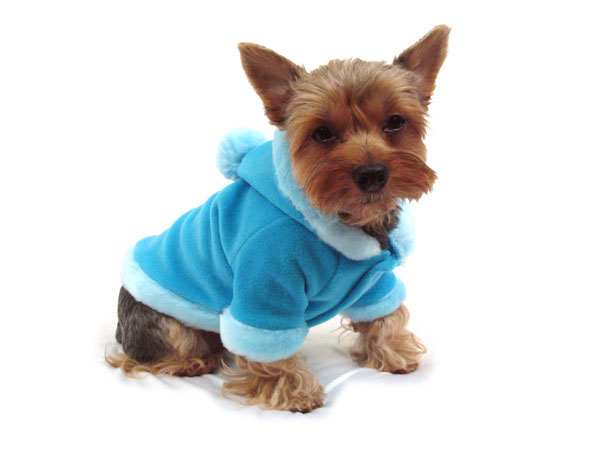
Our diva deluxe is wearing the http://www.dogclothes-apparel.com/ Blue Faux Mink Pom Dog Hoodie. Also available in Pink.

Tuesday, January 24, 2006

Traveling With Your Dog

Traveling with your pet can be more hassle-free if you know what to do. Hotels have become more dog friendly, so here are a few ways to reciprocate.

If you need to go out, take your dog with you. A dog left alone in a strange room may become agitated, nervous and upset with anti-social behaviors to foll0w such as barking, chewing, wetting, or digging.

Walk your dog before going to the room. An empty bladder is a happy carpet.

Take something along which makes your dog feel at home. A favorite toy or a blanket will help ease your dog's nervousness about being in a new place.

Spend some time with your pet in her new surroundings. If she seems hesitant about a certain area or item in the room, explore it together to help put her mind at ease.

Look for any itmes in the room which may be dangerous for your dog. Put any small items which could be harmful out of reach.

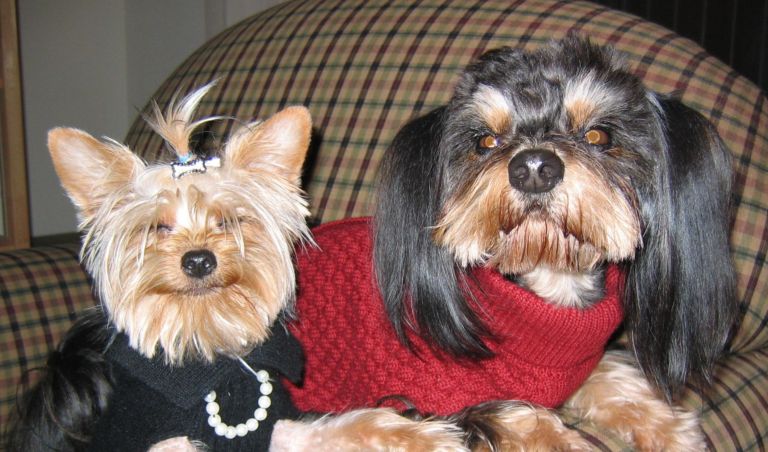
These two lovelies are Penelope and Parker, part of our dogclothes-apparel photo gallery for January. To add your pup to our pictures go to http://www.dogclothes-apparel.com/ and click on Photos.